About ICWES
The International Conference of Women Engineers and Scientists (ICWES)
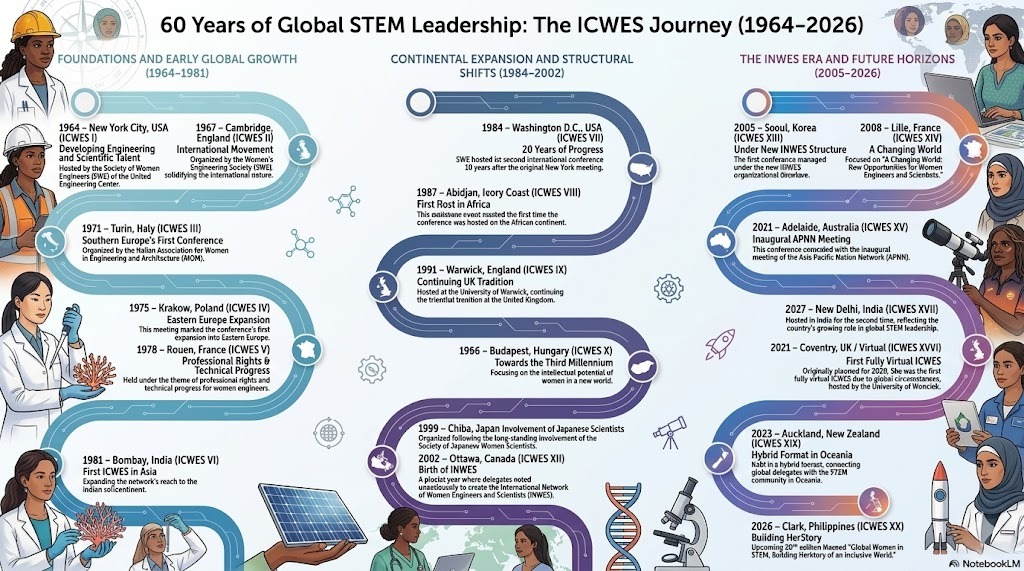
The International Conference of Women Engineers and Scientists (ICWES) is a premier global event that has united women professionals, researchers, and experts in Science, Technology, Engineering, and Mathematics (STEM) since 1964. Held every three to four years, these conferences serve as a catalyst for fostering international goodwill, promoting the exchange of innovative ideas, and facilitating global collaboration to empower women and girls in technical fields.
Since 2002, ICWES has been managed by the International Network of Women Engineers and Scientists (INWES), a global network established with the support of UNESCO during the 12th ICWES conference.
Chronological History of ICWES Conferences
Impact and Evolution
The inaugural 1964 conference marked the birth of a formalized, transnational movement to support women in technical fields. While organizers initially anticipated 300 participants, the event drew over 500 attendees from 35+ countries, signaling a profound global demand for representation.
Today, ICWES has evolved into a multi-dimensional platform. It functions simultaneously as:
-
A Research Stage: Presenting cutting-edge advancements in fields ranging from climate-smart agriculture to Artificial Intelligence.
-
An Advocacy Forum: Addressing critical social barriers such as gender disparities and unconscious bias.
-
A Policy Incubator: Developing the reforms necessary to build an inclusive and equitable global workforce.
Upcoming Event: ICWES 20 is scheduled for August 4–7, 2026, at the Clark Freeport & Economic Zone, Pampanga, Philippines.
| Edition | Year | Location | Key Highlights & Hosts |
|---|---|---|---|
| ICWES 1 | 1964 | New York City, USA | Hosted by the Society of Women Engineers (SWE); coincided with the World's Fair. |
| ICWES 2 | 1967 | Cambridge, England | Hosted by the Women's Engineering Society of Great Britain. |
| ICWES 3 | 1971 | Turin, Italy | |
| ICWES 4 | 1975 | Krakow, Poland | |
| ICWES 5 | 1978 | Rouen, France | |
| ICWES 6 | 1981 | Bombay, India | |
| ICWES 7 | 1984 | Washington, D.C., USA | Hosted by the Society of Women Engineers (SWE). |
| ICWES 8 | 1987/88 | Abidjan, Ivory Coast | Recorded in various sources as either 1987 or 1988. |
| ICWES 9 | 1991 | Warwick, England | |
| ICWES 10 | 1996 | Budapest, Hungary | |
| ICWES 11 | 1999 | Chiba/Tokyo, Japan | |
| ICWES 12 | 2002 | Ottawa, Canada | Historic Milestone: Unanimous vote to establish INWES. |
| ICWES 13 | 2005 | Seoul, South Korea | |
| ICWES 14 | 2008 | Lille, France | |
| ICWES 15 | 2011 | Adelaide, Australia | |
| ICWES 16 | 2014 | Los Angeles, USA | |
| ICWES 17 | 2017 | New Delhi, India | |
| ICWES 18 | 2021 | Virtual / Coventry, UK | First fully virtual conference; hosted by the University of Warwick. |
| ICWES 19 | 2023 | Auckland, New Zealand | Hybrid format hosted by AWIS and Engineering New Zealand. |
| ICWES 20 | 2026 | Pampanga, Philippines | Theme: "Global Women in STEM: Building HerStory of an Inclusive World" |
Leadership History and Executive Team
The following table documents the leadership of INWES since its formalization, highlighting the diverse international representation within its executive board.
| Period | President (Org, Country) | Secretary General | Treasurer |
|---|---|---|---|
| 2002–2005 | Monique Frize (Pathmaker’s Program, Canada) |
Claire Deschenes (AFFESTIM, Canada) | Gail Mattson (SWE, USA) |
| 2005–2008 | Monique Frize (Pathmaker’s Program, Canada) |
Claire Deschenes (AFFESTIM, Canada) | Gail Mattson (SWE, USA) |
| 2008–2011 | Sue Bird (WES, UK) |
Nadia Ghazzali (AFFESTIM, Canada) | Gail Mattson (SWE, USA) |
| 2011–2014 | Kong-Joo Lee (KWSE, S. Korea) |
Liette Vasseur / Jung Sun Kim | Joan Graf (SWE, USA) |
| 2014–2017 | Kong-Joo Lee (Individual, S. Korea) |
Margaret Ajibode (WES, UK) | Joan Graf (SWE, USA) |
| 2018–2020 | Gail Mattson (AAAS/Individual, USA) |
Caroline Thoruwa (AWSE, Kenya) | Sylvia Kegel (DIB, Germany) |
| 2021–2023 | Jung Sun Kim (Dongseo Univ, S. Korea) |
Mary Mwangi (AWSE, Kenya) | Sylvia Kegel (DIB, Germany) |
| 2024–2026 | Sarah Peers (NMITE, UK) |
Kadiata Ba (AFFESTIM, Canada) | Sylvia Kegel (DIB, Germany) |